
UnGovr Podium
ConceptOverview
Every day, thousands of city councils, county boards, school boards, and special districts hold public meetings across the United States. Agendas are buried on government websites, minutes take weeks to publish, and public comment — the democratic right to speak — is constrained to a three-minute window that rarely gets a response.
UnGovr Podium would change that. Podium is the public-comment layer of UnGovr Words — where Words is the on-the-record account of what officials say in the chamber, Podium focuses on the other side of the room: the public. It would crawl government websites for upcoming meeting schedules and agendas, then let you browse and comment on any agenda item directly through UnGovr — abstracting away each government's intake process. Building on the attributed transcripts and minutes from Words, Podium would track whether public comments actually get addressed — producing a responsiveness score for every government entity.
What Podium Tracks
Podium would monitor every public-facing meeting artifact a government entity publishes. The crawler would check for new content daily, and transcripts would be processed as they become available.
- Agendas — upcoming meeting items, staff reports, draft resolutions
- Minutes — official record of what was discussed and decided
- Transcripts — full meeting audio/video converted to searchable text
- Public comments — written comments published to the web before or after meetings
- Actions & votes — motions, vote tallies, and follow-up assignments
Comment Through UnGovr
Podium would let you comment on any upcoming agenda item — or submit general public comment — directly through UnGovr. Each government entity has its own intake process: some accept email to a clerk, some have web forms, some require physical mail. Podium would abstract all of this.
You would write your comment, and UnGovr would route it through the correct channel. After submission, Podium would monitor the next two meetings for any mention or action related to your comment.
Comment Responsiveness
Many public comment periods are performative — residents speak for three minutes, the board says “thank you,” and the meeting moves on. Podium would measure whether that changes.
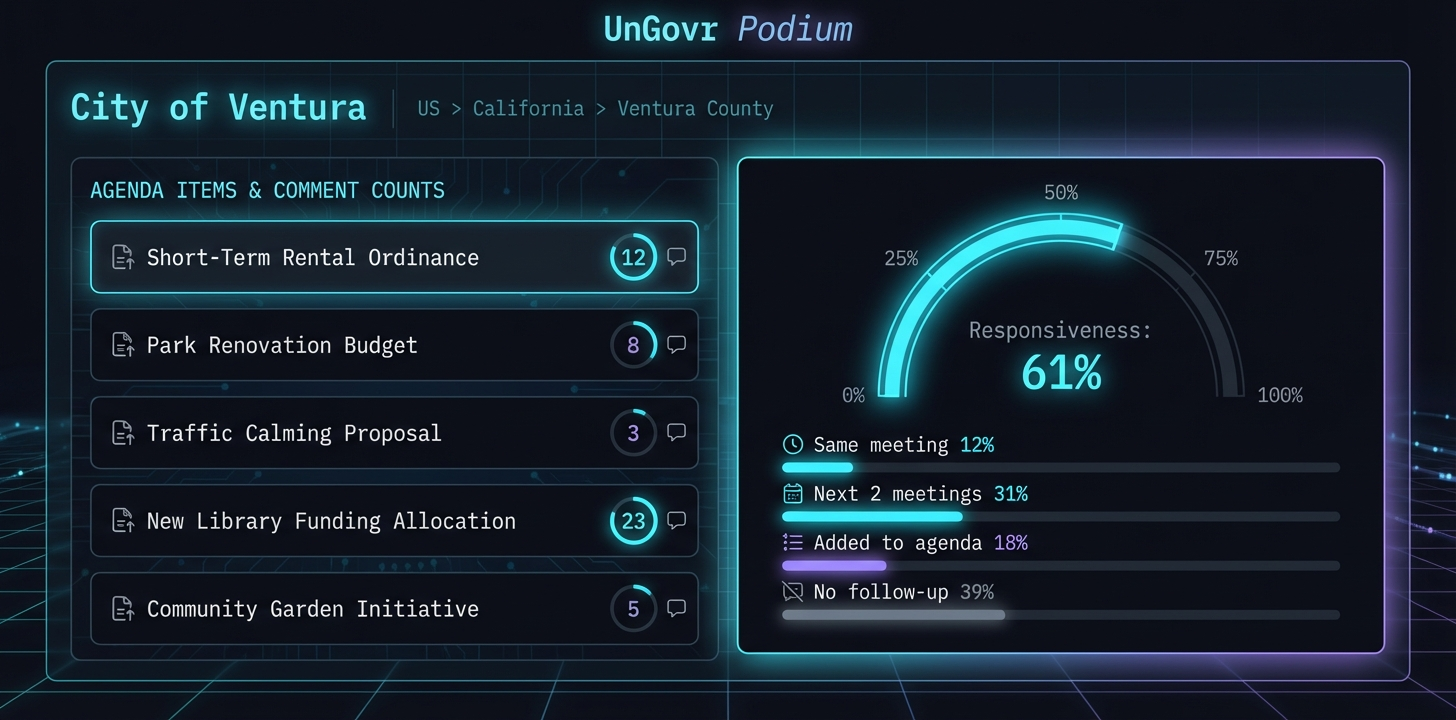
For every public comment, Podium would search subsequent meeting transcripts, agendas, and minutes for evidence that the topic was discussed, added to a future agenda, or acted on. The result would be a responsiveness score for each government entity — a new kind of civic metric that's never been tracked at scale.
How It Works
Meeting Discovery
→ scan https://cityofventura.ca.gov/AgendaCenter
→ found 12 upcoming meetings across 4 bodies
→ parse City Council (3) | Planning Commission (4) | Design Review (3) | Housing Authority (2)
→ ingest 47 agenda items, 23 staff reports, 8 draft resolutions
→ history fetched minutes for last 6 months (18 meetings)
✓ ventura indexed — next council meeting: Apr 8, 2026 7:00 PM
Commenting on an Agenda Item
→ item 7B: “Proposed Short-Term Rental Ordinance Amendment”
→ format City of Ventura accepts: email to cityclerk@cityofventura.ca.gov
→ submit comment routed via UnGovr → city clerk inbox
→ confirm tracking ID: PDM-2026-04-08-7B-0042
→ notify you'll get an alert if this item is discussed or deferred
✓ comment submitted — monitoring next 2 meetings for response
Comment Effectiveness
→ analyze 18 meetings, 142 public comments, 94 agenda discussions
→ match comments ↔ agenda items ↔ follow-up actions
→ score same-meeting response: 12% (17/142)
next-2-meetings response: 31% (44/142)
added to future agenda: 18% (26/142)
no follow-up found: 39% (55/142)
✓ ventura responsiveness: 61% — above median for CA cities